Inline Wastewater Filter
Carbon Nanofibre Microplastic Capture
A distributed, retrofittable filter system designed to capture microplastics, synthetic fibres, and chemical surfactants at the point of discharge — in homes, buildings, and municipal infrastructure — rather than relying solely on centralised treatment facilities downstream.
Filter Concept — Technical Render
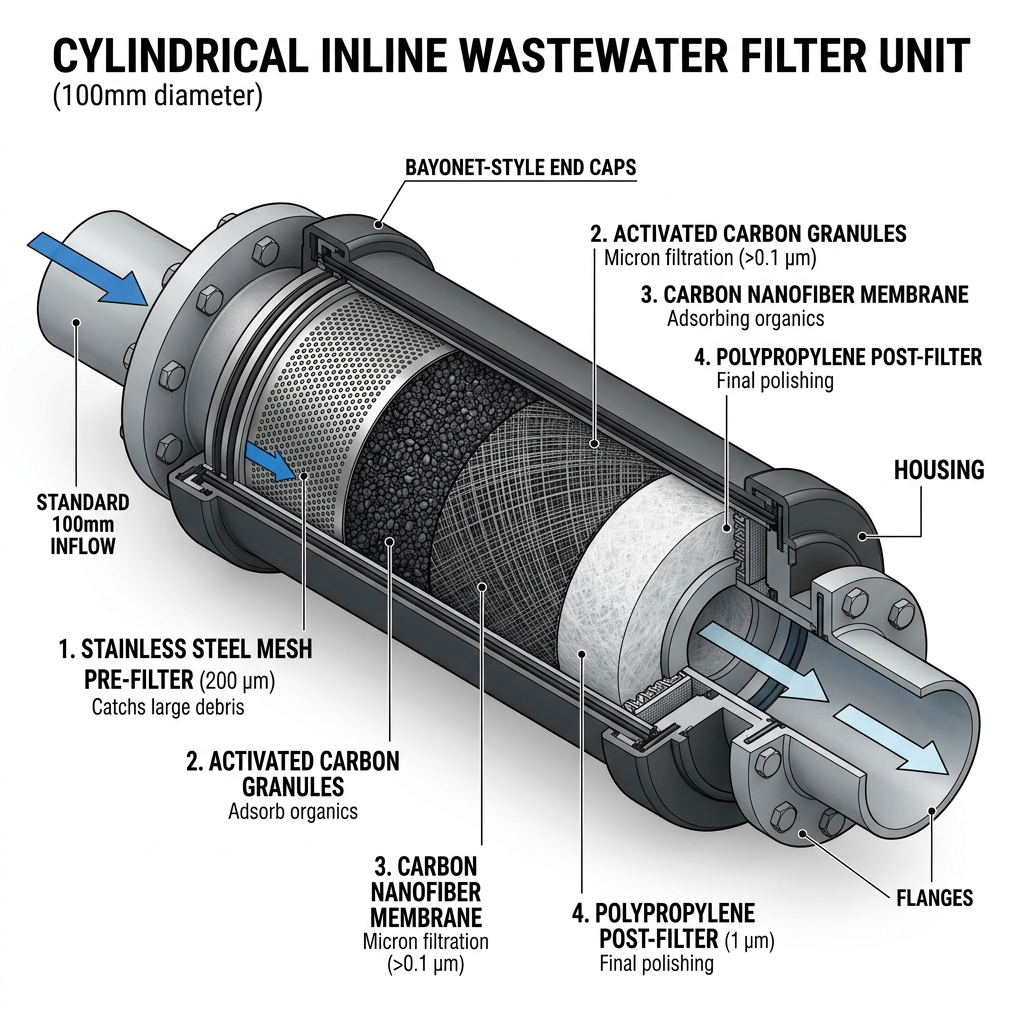
Cutaway concept render showing layered filtration stages. Bayonet-fit end caps allow installation on existing waste pipework without pipe cutting. Direction of flow: left → right.
The Problem
Microplastics are escaping at the source.
synthetic fibres released per washing machine cycle
of ocean microplastics originate from synthetic textiles laundering
of microplastics captured by conventional sewage treatment
Centralised water treatment plants were not designed to capture particles at the 1–100 micron scale. By the time water reaches them, microplastics are thoroughly mixed, diluted, and far harder to remove. Distributed point-of-source capture is far more efficient — and retrofittable into existing infrastructure today.
Filtration Architecture
Stainless Steel Pre-Mesh
Layer 1Captures lint, hair, and macro debris before it clogs deeper layers
Targets: Fibres, lint, hair, food particles
Activated Carbon Granules
Layer 2Adsorbs surfactants, soaps, detergents, and dissolved organic compounds
Targets: Surfactants, chlorine, detergents, odours
Carbon Nanofibre Membrane
Layer 3The core filtration stage — nano-scale fibres physically trap microplastics as small as 1 micron, while their hydrophobic surface chemistry repels and captures synthetic polymer particles
Targets: Microplastics (1–5000μm), nanoplastics, synthetic fibres, surfactant residues
Polypropylene Post-Filter
Layer 4Final mechanical barrier — captures any carbon particles shed from upstream layers and provides structural support
Targets: Carbon fines, residual particulates
Why Carbon Nanofibres?
The material science case
Exceptional surface area
Carbon nanofibre membranes present surface areas of 200–1000 m²/g — orders of magnitude greater than conventional filter media — allowing vastly more capture sites per unit volume.
Hydrophobic surface chemistry
CNF surfaces can be functionalised to be hydrophobic, actively repelling water while attracting and retaining synthetic polymer microplastic particles.
Sub-micron filtration
Electrospun CNF membranes achieve pore sizes of 0.1–10 microns — capable of capturing the smallest detectable microplastic particles while maintaining viable flow rates.
Scalable manufacturing
Electrospinning and vapour-grown carbon fibre (VGCF) processes are already in commercial production for battery and filtration applications, with costs falling year-on-year.
Deployment Scale — From Tap to Global Retrofit
Washing Machine Outlet
Domestic / CommercialFitted inline on the waste hose of domestic and commercial washing machines. A single machine can release up to 700,000 synthetic fibres per wash cycle — this is the point of first intervention.
Household Waste Stack
DomesticInstalled on the main waste pipe stack of a property, capturing pollutants from all sinks, showers, and appliances before they reach the sewer.
Building-Level Retrofit
Commercial / InstitutionalIntegrated into the waste infrastructure of apartment blocks, hotels, hospitals, and commercial premises — capturing microplastics at scale from entire buildings.
Municipal Sewer Mains
MunicipalLarger-diameter versions fitted to sewer main junctions — a distributed network approach that supplements or replaces dependence on centralised water treatment plants.
Industrial Outflow
IndustrialHigh-capacity units for textile factories, laundries, and manufacturing facilities — the source of the highest-concentration microplastic discharge.
The Bigger Vision
Retrofitting the world's pipework
Rather than waiting for the replacement of centralised wastewater infrastructure — a multi-generational project — this concept proposes a parallel, distributed network of point-source filters that can be retrofitted to existing pipework globally, using standardised bayonet coupling compatible with the most common pipe diameters: 40mm (sink/shower), 50mm (bath/basin stack), and 100mm (soil/main waste stack).
The open-source design philosophy of this project means filter specifications, coupling standards, membrane formulations, and installation guides would be freely available — enabling manufacturers in any country to produce compatible units, and any competent plumber to install them. Centralised treatment plants remain important, but this approach means the water arriving at them is already dramatically cleaner.
Open R&D Challenges
Filter saturation & replacement cycle
Open ChallengeCarbon nanofibre membranes will eventually saturate. Developing compostable or regenerable membrane cartridges is an active R&D priority.
Pressure drop across the filter
Open ChallengeMulti-layer filtration creates resistance. Unit design must balance filtration thoroughness against acceptable flow rate reduction.
Cost of carbon nanofibre at scale
Promising ProgressCNF production costs have dropped significantly (2020–2025). Electrospun CNF membranes are approaching commercial viability for consumer applications.
Retrofit compatibility with legacy pipework
Promising ProgressBayonet and compression-fit coupling designs allow installation on standard 40mm, 50mm, and 100mm waste pipe without cutting — a key advantage for global retrofitting.
Disposal of captured microplastics
Open ChallengeThe filter cartridge becomes a concentrated microplastic waste product. Safe disposal and potential material recovery pathways are under investigation.
Interested in contributing to this research?
Join the Discussion